
Number Patterns Activities: Engaging Ways to Master Patterns
You’ll find hands-on activities here that make number patterns feel clear and surprisingly useful for everyday learning. These tasks help you spot rules, stretch sequences, and practice skip counting with objects, number lines, and worksheets for all skill levels.
You can teach or learn number patterns quickly by trying step-by-step activities that show the rule, offer guided practice, and finish with a short challenge to check if you’ve really got it.

Try games and quick exercises with real objects, rhymes, or a number line. These turn abstract sequences into something you can actually see and touch.
The next sections cover key activities that teach the rules and give easy ways to practice—enough to build confidence without making anyone feel overwhelmed.
Essential Number Patterns Activities
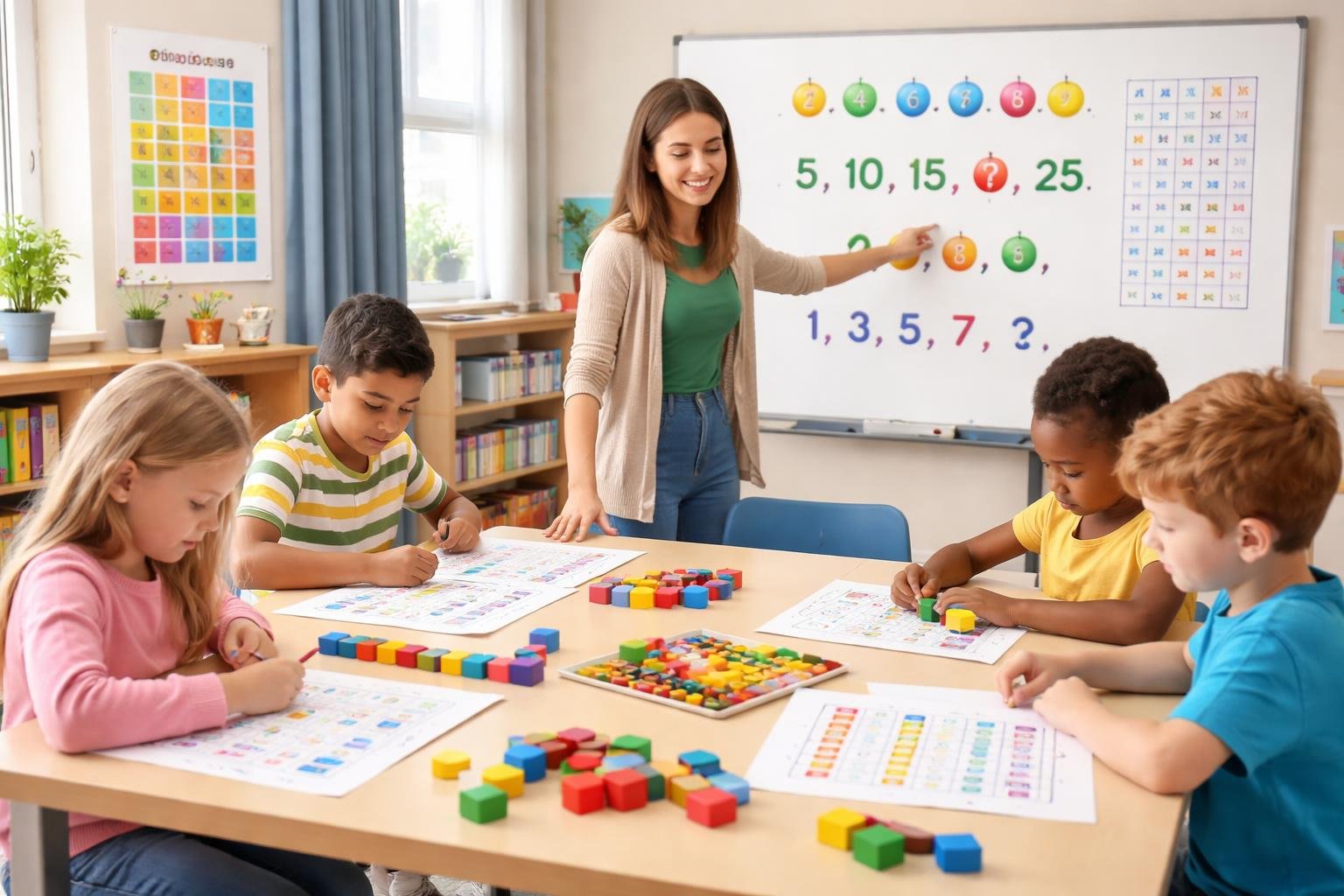
These activities help you spot rules in lists of numbers, count in steps, and stretch sequences by using simple rules. You’ll work on finding the rule, predicting what comes next, and writing the rule in words or symbols.
Pattern Recognition and Prediction
Start with short sequences—think 2, 4, 6, 8 or 5, 10, 15—and ask what changes each step. Point to the difference between terms and ask, “What comes next?” That builds number sense and helps you spot addition, subtraction, or repeating patterns fast.
Mix visuals and numbers. Show patterns on a number line or with counters so you can see the jump size. Try missing-number cards: 3, __, 9, 12. Can you predict what fits?
Make quick rules: “add 3” or “multiply by 2.” Write the rule in words and as a simple expression like +3 or ×2. Doing both strengthens your understanding and gives you tools to explain your thinking.
Skip Counting and Number Sequences
Skip counting means counting by a fixed step—by 2s, 5s, or 10s. Practice with real tasks: count nickels for 5s, mark every third step on a photo of stairs, or clap every fourth beat. This links counting patterns to real life and makes fluency stick.
Work with number lines and charts. Fill in blank spots on a 100-chart by skip counting, so you can see bigger jumps. Try sequences that start at different numbers (like 7, 10, 13) to learn shifts and steps.
Challenge yourself with reverse skip counting (going backward) to see if you can predict earlier terms. It’s a good way to test if you really get the pattern.
Number Pattern Rules and Extensions
Once you can name simple rules, practice stretching patterns with mixed operations. For example, if you see 4, 7, 11, 16, ask for the next two terms and the rule. Decide if the rule is “+3, +4” or maybe “add increasing numbers.” Write the rule out clearly.
Try tasks that make you choose between rules. Look at sequences like 2, 4, 8, 16 and 2, 5, 8, 11. Which rule fits each? Then extend the pattern five steps. Translate rules into equations (n+3, 2n) so you can extend without always recounting.
Practice describing rules in words and symbols, and test extensions forward and backward. This builds prediction skills and helps you spot patterns that use alternating or growing changes.
Engaging Practice with Number Patterns
You’ll find practical tools, hands-on methods, and clear lesson steps here to help students spot rules, extend sequences, and build fluency with addition, subtraction, multiplication, and early algebra. Activities use printable worksheets, number lines, manipulatives, and short lesson plans for school or home.
Number Patterns Worksheets and Resources
Pick number patterns worksheets that fit the skill level—counting worksheets for beginners, pattern worksheets for repeats, and number pattern worksheets that use addition or subtraction rules. Try free worksheets with missing-number problems, growing and shrinking sequences, and times tables patterns.
Mix up the formats: printable pdfs for homework, digital interactive sheets for the classroom, and short timed drills for fluency. Add prompts that ask students to describe the rule in words or write an algebraic rule like “add 3” or “×2”.
Label each worksheet with its skill focus and a time estimate (5–15 minutes). Include answer keys and extension tasks, like challenge rows that combine operations or lead into simple algebra. Keep practice short and varied to hold attention.
Using Number Lines and Manipulatives
Number lines let you show jumps visually for addition and subtraction patterns. Draw lines with equal marks and have students hop to follow the rule, like +4 or −2. This builds number sense and helps with counting worksheets that tie into sequence work.
Use counters, cubes, or stickers to model patterns physically. For multiplication patterns and times tables, arrange groups of items so students can see repeated addition. For growing and shrinking sequences, add or remove pieces to show change.
Change up materials each week so students get practice reading, writing, and building patterns. Pair manipulatives with quick writing prompts: “Write the next three numbers and the rule.” This links hands-on work to patterning worksheets and written practice.
Applying Arithmetic Operations
Teach pattern rules by operation type: addition patterns (add 2, add 5), subtraction patterns (drop by 3), and multiplication patterns (×2, ×5). Start with clear examples, then give sets of problems where you extend sequences and find missing numbers.
Add in mixed-operation worksheets to nudge students toward algebraic thinking. Ask them to name the rule in words and as an equation, like “start 4, add 6: 4, 10, 16” or “n × 3.” Use times tables to show repeated patterns and help with faster mental math.
Try short quizzes and quick drills for counting speed. Record time and accuracy to track progress. If you get stuck, use number lines or manipulatives to reinforce the concept.
Lesson Plans for Classroom and Home
Create lesson plans that last about 10–30 minutes. Set clear goals—maybe identifying rules, extending number sequences, or writing simple equations.
Start things off with a warm-up. You could use a counting worksheet or toss in a quick pattern-matching activity.
Move on to a guided group activity. Group pattern worksheets or number line hops usually work well.
Wrap up with an independent task. Printable worksheets are handy for this part.
If you’re working at home, hand out a small stack of number pattern worksheets. Throw in something hands-on, like a number line or a few counters.
Set easy targets. Ask kids to finish 8 items, explain the pattern rule in one sentence, and write it out as an equation if they can.
In the classroom, mix it up for different levels. Offer simple counting worksheets to beginners and patterning worksheets with a bit of algebra for the more advanced students.
Keep track of how things go. Tweak the next lesson based on what you see—go over tricky rules again, and add a few timed times tables or subtraction drills if those seem needed.