Uses of Maths in Daily Life: Essential Everyday Applications
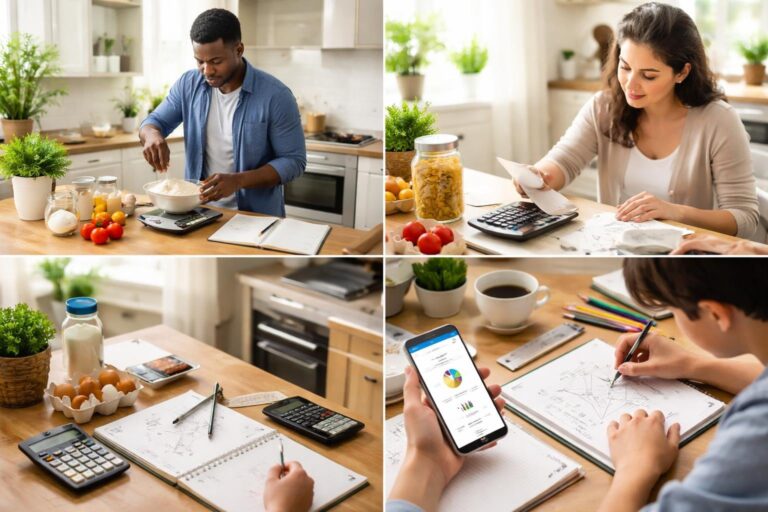
You probably use math way more than you realize—whether you’re cooking, planning a trip, managing your cash, or just keeping track of time. Math steps in to help you solve quick problems and make smarter decisions almost every day.

Math pops up when you measure ingredients, figure out discounts, plan out travel time, or try to keep your budget in check. Picking up a few basic skills really does save you time and money.
Let’s look at some practical ways to use math at home and beyond. I’ll toss in examples you can try right now to make life just a bit easier.
Core Uses of Maths in Everyday Life

You rely on basic math every day—managing money, comparing prices, or following recipes. Simple arithmetic, percentages, and ratios help you avoid mistakes and save a little time.
Budgeting and Managing Personal Finance
You make a budget using math. Add up your monthly income, jot down fixed bills (like rent or utilities), and estimate what you’ll spend on things like food or transport.
Subtract those expenses from your income to see what’s left to save.
Percentages come in handy when you calculate interest on savings or loans. Say you’ve got £1,000 and a 3% interest rate—you’ll earn £30 in a year.
Try this formula: Interest = Principal × Rate × Time. When you track expenses by category, you spot places to cut back.
Math also helps you plan for goals. If you want £600 in six months, divide by six—so you’ll need to save £100 every month.
A few small changes in spending can really add up. Basic arithmetic and understanding percentages keep your finances healthy.
Shopping and Calculating Discounts
You use math to figure out which deal is best. Compare unit prices by dividing the price by the weight or volume.
Take a 500 g jar at £2.50—that’s £0.005 per gram. Check bigger sizes and see if you’re really saving.
When you spot a 25% discount, multiply the price by 0.75. So a £40 item drops to £30.
If you need to add sales tax, just multiply the price by (1 + tax rate). For a 5% tax, that’s 1.05.
Watch out for deals like “buy one get one half price.” Add the full price plus half price, then divide by two to get the real cost per item.
A little quick math keeps you from falling for clever marketing.
Cooking, Baking, and Measuring Ingredients
You use ratios and proportions every time you tweak a recipe. If a cake for 8 needs 300 g flour but you only want 4 servings, just halve it—300 g ÷ 2 = 150 g.
Want to triple a recipe? Multiply everything by 3.
Sometimes you need to convert units because your measuring cups or spoons don’t match the recipe. Here’s a quick guide:
- 1 cup ≈ 240 ml
- 1 tablespoon = 15 ml
- 1 teaspoon = 5 ml
Baking really depends on accurate measurements and simple fractions. If you eyeball it, you might end up with a cake that’s too dense or too dry.
Scaling recipes and converting units use basic math, but they make all the difference for your food.
Practical Applications of Mathematics at Home and Beyond
Math sneaks into your day when you measure, plan, or make decisions. Even simple calculations or shapes come in handy for projects, health, and travel.
Home Improvement, Renovation, and DIY Projects
When you take on a renovation, geometry and algebra guide your choices. Measure a room’s length and width, then calculate area to figure out how much flooring or paint to buy.
For floors and walls, use area = length × width. Don’t forget to subtract windows and doors.
If you need to find a roof slope or stair angle, right-triangle rules or trigonometry help you out.
Here’s a quick table for estimating materials:
- Flooring: area (m²) × 5–10% for waste
- Paint: wall area ÷ coverage per litre
- Tiles: floor area ÷ tile area, then add a bit for grout
You’ll also use algebra for unit conversions, scaling plans, or adjusting a recipe for custom cabinets.
Software tools and basic algorithms can help you make cutting lists or cost estimates. Counting out screws, nails, or timber lengths accurately saves money and hassle.
Health, Fitness, and Medicine
Math helps you keep track of your health with real numbers. Calculate your BMI using weight and height to check if you’re in a healthy range.
Count calories and break down macronutrients with ratios for meal planning. Track your progress by averaging your results over a few weeks.
Medicine relies on precise doses and conversions. Nurses and pharmacists use math to scale drug doses based on your weight (mg/kg).
You interpret test results with percentages and use probabilities to understand risks.
In fitness, you calculate target heart rate zones or pace for a run. Recording measurements and checking basic statistics help you spot changes and make smarter choices.
Travel Planning and Time Management
Honestly, good travel starts with a bit of math. You estimate travel time by dividing distance by speed, then toss in a buffer for traffic—because, let’s face it, delays happen.
Grab a map or open your favorite app to measure distances and check out different routes. When you think about fuel, just multiply distance by your car’s fuel consumption per kilometer, then by the current fuel price. It’s not fancy, but it works.
When you make a schedule, keep it simple. Add or subtract hours and minutes to figure out how much time you really have. Block out chunks for important tasks, and try to guess how long each one will actually take so you don’t end up scrambling.
If you’re budgeting for tickets or a place to stay, percentages and basic interest formulas come in handy. I always compare options by looking at the price per night or per mile—it saves a lot of hassle. Doing these quick calculations makes your trip smoother and cuts down on those last-minute surprises.