
Mathematics in Daily Life: Practical Uses and Real-World Impact
You probably use math way more than you realize—like when you plan your money, cook dinner, or try to pick the fastest way across town. Math lets you solve daily problems, make smarter choices, and honestly, it saves you time and money.

Let’s look at how math sneaks into everyday tasks. It powers tech, helps with health stuff, sports, and just regular problem solving.
Check out these simple examples—they’re actually pretty useful.
Essential Applications of Mathematics in Everyday Activities
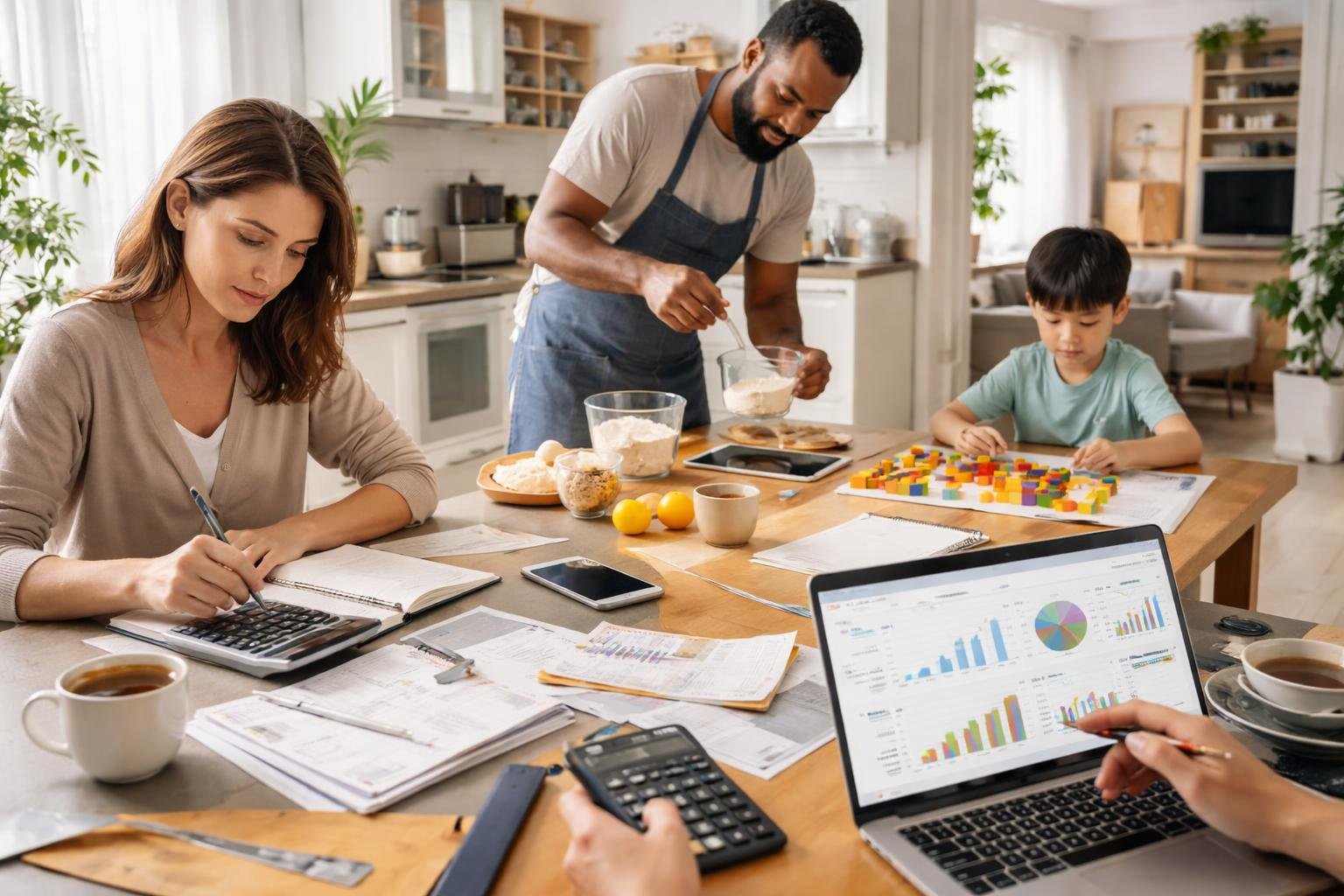
You lean on numbers to make choices, save money, and get things done faster. Small calculations—like figuring out percentages for discounts or using basic geometry to hang a shelf—really do help you avoid mistakes.
Budgeting, Shopping, and Financial Decision Making
When you plan your money, you list your income and fixed expenses, then subtract to see what’s left for savings or fun stuff. You use basic math to add up bills and percentages to set savings goals—like saving 10% of your income.
At the store, you divide cost by quantity to find the unit price and compare value. If there’s a sale, you multiply the price by the discount percentage (so 20% off is price × 0.20) and subtract that from the original price.
Sales tax adds a percentage, so you tack on price × tax rate to what you pay. Ratios help you split costs or compare deals (like 2 for $5 vs. $3 each). If you need to solve for unknowns—like figuring out the monthly payment you can afford—algebra steps in.
Keeping simple records and using formulas makes your choices clearer and helps you avoid overspending.
Cooking, Measurements, and Kitchen Math
You follow recipes by measuring ingredients and sometimes converting units. If you need to switch between cups, grams, or milliliters, you use conversion factors or just multiply.
Say a recipe for four needs to serve six. You scale each ingredient by 1.5 (since 6/4 = 1.5) and multiply everything by that.
If you want to cut sugar by 25%, you multiply the sugar amount by 0.75. Sometimes you need to convert temperatures between Celsius and Fahrenheit, which takes a simple formula.
Baking especially depends on getting ratios and proportions right—mess those up and the cake might flop. Measuring tools, timers, and a bit of arithmetic keep things consistent (and edible).
Time Management and Scheduling
You break up your day by blocking out time and using quick math. Add up how long tasks take to see if they’ll fit in your schedule.
Subtract to find free time, and use percentages to set priorities—maybe spend 60% of your study time on the hardest subject. If you want to estimate how long something takes, time it a few times and average the results.
When you split tasks, ratios help—if one person works twice as fast, you assign work in a 2:1 ratio. To figure out deadlines, just add the hours needed to the current time. Checking for overlaps helps you dodge double-booking and chaos.
Home Improvement and Geometry in Practice
You measure spaces, calculate areas, and estimate materials using geometry and arithmetic. For painting, you multiply wall width by height to get area, then divide by paint coverage per liter to see how much you’ll need.
Flooring needs area calculations too, plus a little extra—add 5–10% for waste. When you fit shelves or corners, you check right angles with the Pythagorean theorem.
Scaling plans? If a blueprint uses 1 cm = 1 m, just multiply by 100. Cutting boards or tiles means measuring carefully and sometimes using a bit of algebra to make things fit.
Getting the math right saves you money by avoiding extra trips to the store or expensive mistakes.
Mathematics in Technology, Health, Sports, and Problem Solving
Now, let’s see how math powers your gadgets, helps with health choices, tracks sports stats, and sharpens your decisions. You’ll notice tools like algorithms, stats, and optimization popping up in apps, clinics, and even games.
Technology and Mathematical Algorithms
Math runs under the hood of the tech you use every day. Algorithms rely on arithmetic, linear algebra, and calculus to sort search results, recommend videos, or shrink images.
For example, matrix operations and eigenvectors help computers recognize images, while differential equations model how signals change in wireless networks.
Cryptography protects your data by using number theory and modular arithmetic. Public-key systems depend on prime factorization and discrete math.
When you code, you use computational complexity to pick methods that run faster and don’t drain your battery. Optimization tools like linear programming help with route planning and resource allocation.
You’ll also see Fibonacci-style sequences and recurrence relations in data structures and caching. Knowing a bit about these concepts helps you figure out why some apps feel faster or more secure than others.
Sports, Statistics, and Probability
Stats and probability turn raw sports actions into clear numbers. Batting average or shooting percentage? Just simple ratios.
Advanced metrics combine plays with weights to build player efficiency or win-probability models. You can use probability to weigh risks during a game or pick a strategy.
Coaches lean on statistical models and game theory to plan plays or substitutions. Regression and time-series analysis reveal trends, like a hitter’s hot streak or a team’s defensive slump.
With all the data collected now, analysts can track thousands of events per game. Wearable sensors spit out data, which gets cleaned up, modeled, and visualized to help with scouting, training, and decisions mid-game.
Teams use math to lower injury risks and boost tactics—and honestly, fans benefit from smarter play.
Health, Fitness, and Data Analysis
Math helps you make sense of your body and treatments. Body mass index (BMI) uses a basic formula to compare weight and height.
Health researchers rely on statistics, regression, and survival analysis to study drug effects and patient outcomes. In fitness, you use arithmetic and percentages to track calories, macros, and progress.
Wearables collect your heart rate and motion data, and algorithms turn that into steps, recovery scores, or VO2 estimates. Clinicians use differential equations and compartment models to see how drugs move through your body.
Public health officials use data analysis to spot outbreaks and measure vaccine impact. If you know a little about probability and sampling, you’ll read health news with a more critical eye—and spot shaky study claims.
Critical Thinking and Decision Making
Mathematical thinking really sharpens your reasoning for daily choices. You break down tough problems into smaller, manageable pieces and test them out.
When you’re making purchases or planning a trip, you probably rely on cost-benefit calculations, expected value, or just simple probability. It’s surprising how often these ideas pop up.
You can use optimization tricks, like linear programming, to figure out how to spend your time and money when you’ve got limits. Game theory helps you see through competitive situations—think bargaining or even just scheduling stuff with friends.
If you take a clear, step-by-step approach with numbers, you’re less likely to fall into bias traps. Decisions usually turn out better that way.
Try working with small models—maybe a table, a few equations, or even a quick decision tree. These tools help you compare your options without getting overwhelmed.
Honestly, these habits can really boost your judgment at work, in school, or just in everyday life.