
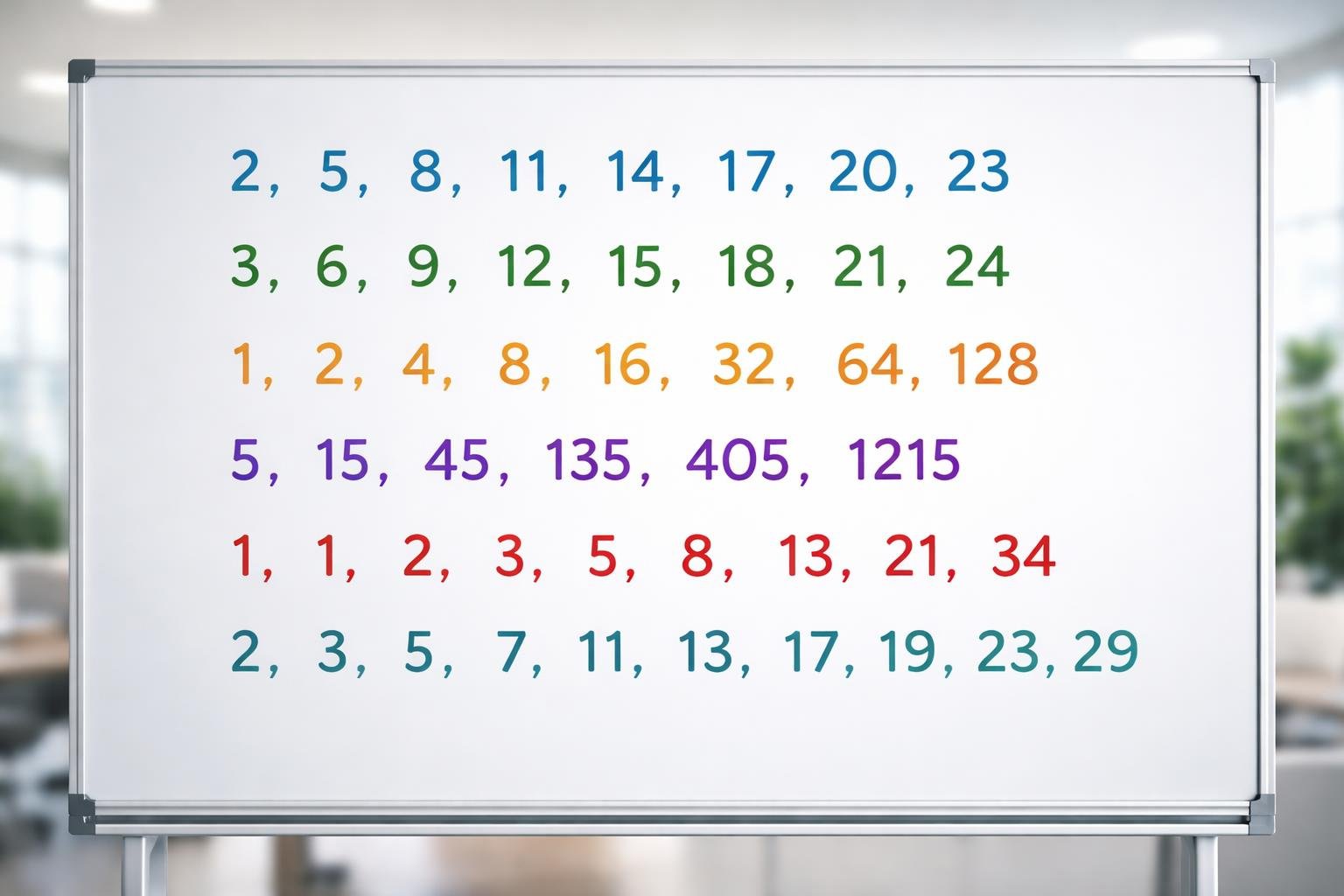
Number Patterns Examples: Types and Step-by-Step Explanations
You probably use number patterns in your daily life without even thinking about it. Think about counting by twos or noticing repeating rules in data. This post lays out some clear examples of number patterns and walks you through simple steps for spotting arithmetic, geometric, square, triangular, and Fibonacci sequences. That way, you can predict the next numbers a little more confidently.
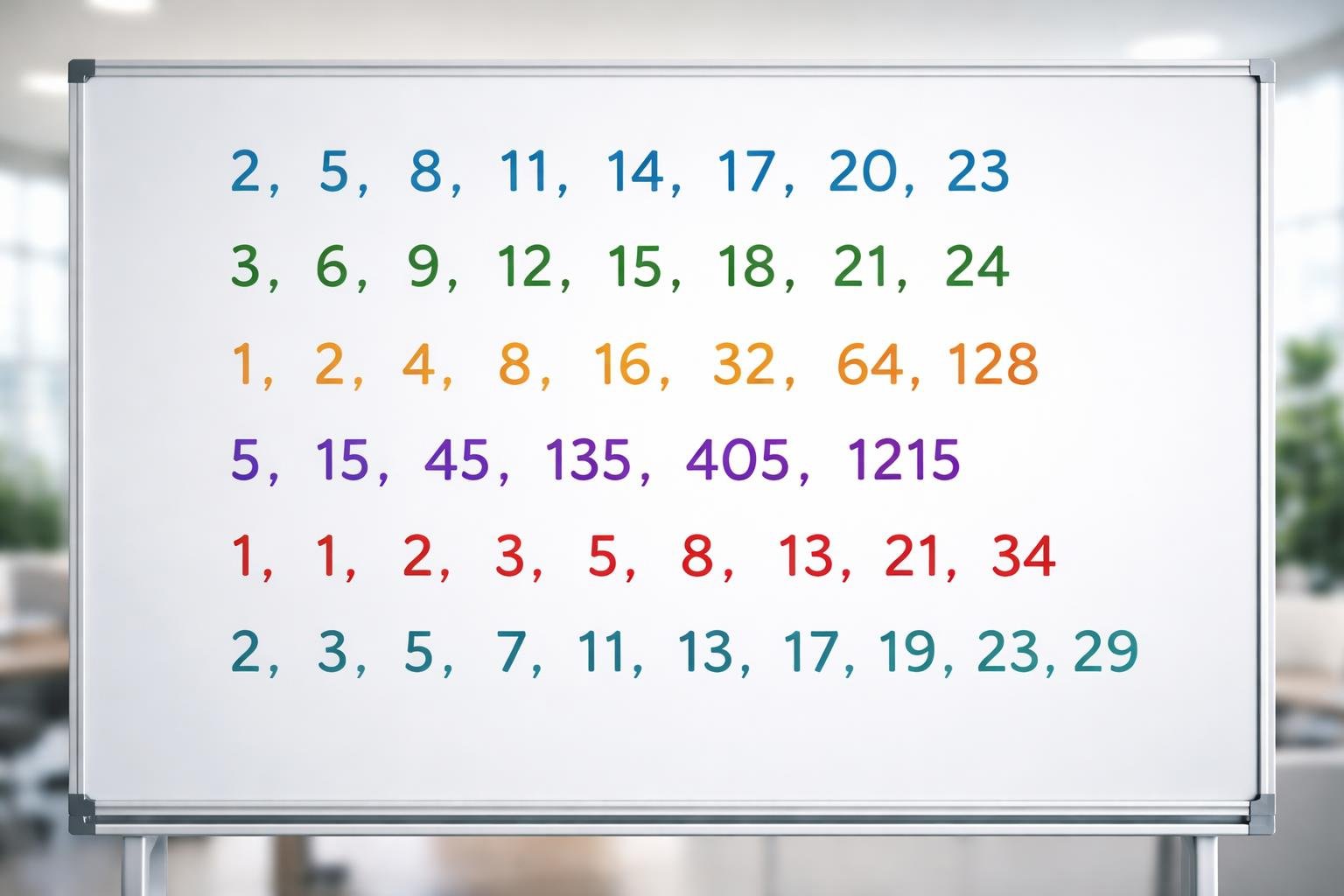
You’ll learn how to find the rule behind a number sequence and quickly figure out the next terms—whether the pattern adds, multiplies, or follows something special like squares or Fibonacci.
Let’s look at some practical examples and easy step-by-step methods that make number pattern problems less intimidating. You might find these tips handy for homework, puzzles, or just thinking about numbers in daily life.
Common Types of Number Patterns

You’ll usually run into three main kinds of number patterns. Some patterns build by adding the same amount each time. Others multiply by the same factor. And then there are special sequences that follow their own rules.
Each type has a clear rule you can use to find missing terms or guess what comes next.
Arithmetic Sequences and Patterns
In an arithmetic sequence, you add the same number at each step. That fixed amount is called the common difference.
For example, in 5, 8, 11, 14, the common difference is 3. You can find the nth term with a formula using the first term and the common difference.
Try arithmetic patterns when numbers grow or shrink by a steady amount, like counting by 4s or when you see a regular increase.
Key features:
- Rule: add (or subtract) a constant.
- Example: 2, 7, 12, 17 (d = 5).
You’ll spot missing numbers by checking the differences. This works for growing or shrinking patterns, and it pops up in lots of word problems.
Geometric Sequences and Patterns
In a geometric sequence, you multiply by the same number each time. That number is the common ratio.
For example, 3, 6, 12, 24 has a common ratio of 2. Use geometric patterns when values scale up or down by a fixed factor, like doubling or halving.
You can write the nth term using the first term and the common ratio.
Key features:
- Rule: multiply (or divide) by a constant.
- Example: 5, 15, 45, 135 (r = 3).
These patterns are great for modeling exponential growth or repeated proportions. Check the ratios between terms to confirm the pattern.
Special and Notable Number Patterns
Some sequences don’t just add or multiply—they follow unique rules.
Examples:
- Fibonacci: each term is the sum of the two previous terms (0, 1, 1, 2, 3, 5).
- Square numbers: n^2 gives 1, 4, 9, 16.
- Triangular numbers: sums like 1, 3, 6, 10.
You’ll find these patterns linked to shapes or real-world rules.
How to work with them:
- Look for a formula (like n^2) or a rule that builds off previous terms.
- Use differences or ratios first to check for arithmetic or geometric structure.
If neither fits, maybe it’s a special pattern—could be repeating groups, sums, or something factorial-like.
Examples and Step-by-Step Identification of Number Patterns
Let’s dig into how you can spot arithmetic and geometric rules, find special sequences like Fibonacci and square numbers, and see how these patterns show up in real life.
The examples keep it simple and show you what to check first—differences, ratios, or special formulas.
Finding Arithmetic Patterns
Start by looking at the differences between consecutive terms. If the difference stays the same, you’ve got an arithmetic sequence.
For example, 5, 8, 11, 14 has a constant difference of +3. The rule is “next = current + d” where d is the common difference.
Quick checklist:
- Subtract each term from the next.
- If all results match, that’s your d.
You can predict future terms by adding d over and over. Arithmetic patterns can go up or down. They work for even numbers, odd numbers, multiples (like multiples of 3), and sequences in whole or natural numbers.
You’ll see them in consecutive numbers or when you spot linear growth in data.
Recognizing Geometric Patterns
To find geometric sequences, check the ratios between terms. If each term equals the previous term times the same number r, that’s a geometric pattern.
Example: 2, 6, 18, 54 has a common ratio r = 3. The rule is “next = current × 3.”
Here’s what to do:
- Divide each term by the one before it.
- If all quotients are the same, that’s your r.
Use the ratio to predict future terms. For descending series, you’ll see fractions. Geometric patterns include powers and cubic sequences when r is a base like 2 or 3.
These patterns relate to growth rates and doubling. Watch out for zeros or sign changes—division doesn’t work if a term is zero.
Understanding Special Patterns: Fibonacci, Square, Cube, Triangular
Special sequences follow their own formulas. The Fibonacci sequence builds by adding the two previous terms: 0, 1, 1, 2, 3, 5, 8…
The rule is “next = previous + one before previous.” Fibonacci pops up in nature and design.
Square numbers follow n^2: 1, 4, 9, 16, 25. These are perfect squares and form the square number pattern.
Cube numbers follow n^3: 1, 8, 27, 64—you get the cubic sequence or cube number pattern.
Triangular numbers count dots forming triangles: 1, 3, 6, 10, 15. Use the formula n(n+1)/2 to get the triangular number sequence.
These special sequences help you spot patterns in arrangements, area models, and problems that ask for perfect squares or triangular counts.
Practical Applications and Real-World Examples
You’ll spot number patterns everywhere—calendars, finance, even in design.
People use arithmetic sequences when they model steady increases, like saving the same amount every week or numbering seats in a row.
Multiples? They pop up in schedules, like when something happens every three days.
Geometric patterns? Think about compound interest or how populations grow. Those use geometric sequences.
Some sequences get a little more special. Fibonacci numbers show up in the way leaves grow on plants.
Square numbers help you figure out areas, and you’ll see triangular numbers in the way bowling pins line up.
Prime and composite patterns? They’re big in cryptography and for checking factors.
When you want to figure out which pattern fits a number series, try quick tests—look at the differences for arithmetic, check the ratios for geometric, or see if the numbers match formulas for squares, cubes, or triangular numbers.