
Examples of Mathematics in Daily Life: Practical Uses Explained
You probably use math more than you realize. Whether you’re splitting a bill or figuring out how long it’ll take to get somewhere, basic math just sneaks into your day. It helps you make quick decisions, save a little time, and maybe dodge a few mistakes. You’ll see real, everyday examples that show how basic math skills solve actual problems at home, at work, or when you’re out and about.

This post looks at common daily tasks where math actually matters—like budgeting, cooking, shopping, or planning a trip. You’ll also spot practical uses in health, planning, and tech that just make life a bit smoother.
Watch for the quick, practical examples you can try right away. It might surprise you how often math pops up, and how handy it can be.
Core Examples of Mathematics in Daily Life
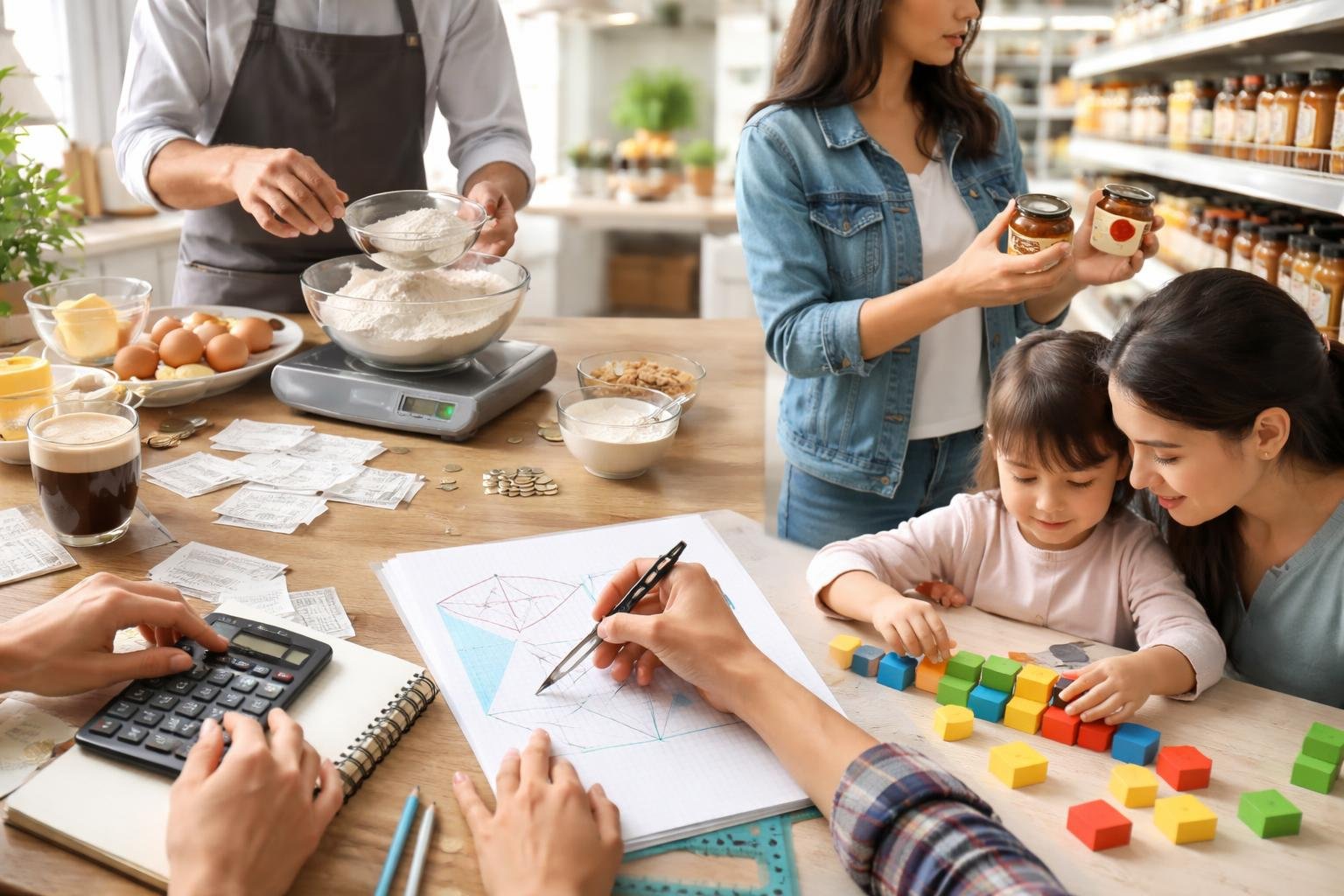
Numbers are everywhere. You use them to make choices, save money, plan meals, or just keep appointments straight.
Simple arithmetic, percentages, unit conversions, and ratios help you make decisions faster and with fewer mistakes.
Budgeting and Personal Finance
You track your income, bills, and savings with basic arithmetic and percentages. Subtract your fixed expenses from your monthly income to see what you can save.
Percentages help you figure out interest on savings or loans, and they make comparing offers easier.
Try making a simple budget table: list your income, fixed bills, variable spending, and savings. Subtract totals to see what’s left at the end of the month.
If you want to model changes—like cutting back on dining out by 10%—just adjust the numbers by that percentage.
Ratios and proportions come in handy when you split money among different goals. Maybe you go with 50% for needs, 30% for wants, and 20% for savings. If your income changes, recalculate the splits.
Unit conversions matter too. You might need to turn your hourly wage into a monthly pay number, or the other way around.
Shopping and Discounts
When you shop, you check prices and discounts using percentages and quick math. To figure out a 25% discount, multiply the price by 0.75.
Add sales tax by multiplying the price by (1 + tax rate). It’s pretty straightforward.
Compare unit prices to figure out if it’s better to buy bigger or smaller packages. Just divide price by quantity (like price ÷ ounces or price ÷ items) to get the best value.
Multi-step deals like “Buy 2, get 1 half off” are a bit trickier. Total up the items, then apply the fraction for the discount.
Mental math shortcuts help a lot. For 10%, just move the decimal. For 25%, take half of 50%. If you estimate totals before checkout, you avoid surprises.
Percentages and unit conversions help you avoid overspending and make sense of coupons or bulk deals.
Cooking and Baking
Cooking is math in action. Recipes depend on measurements, ratios, and unit conversions.
You follow cups, grams, teaspoons, and minutes to get the results you want. If you need to double or halve a recipe, just multiply each ingredient by the same factor.
Sometimes recipes use different systems. You’ll want to know that 1 cup is about 240 mL, or that 1 tablespoon equals 15 mL.
Ratios help with mixes—a 2:1 flour-to-liquid ratio gives a certain dough texture. If you cook a bigger roast, you adjust the time per pound.
Temperature and time conversions, like switching from Fahrenheit to Celsius, keep your food safe and tasty. A little arithmetic goes a long way in the kitchen.
Time Management and Scheduling
You split your day into blocks using arithmetic and a bit of planning math. Add up the durations to see if your schedule really fits.
If a task takes 45 minutes and you have three of them, just add up 45 + 45 + 45. That gives you the total time.
You might use percentages to prioritize—spending 20% of your workday on a project helps you see if you have enough time.
For travel, convert speed and distance into hours (time = distance ÷ speed). Adding a buffer, like 10–15%, to travel or setup times helps you avoid being late.
Use calendars and lists to add up durations and spot any overlaps. Simple math keeps your plans realistic and helps you stay on track.
Further Applications of Mathematics in Routine Activities
Numbers and shapes help you make choices, solve problems, and check your results every day. The examples below show how math keeps travel, health, home projects, and digital tools running smoothly.
Estimating Travel Time and Planning Routes
When you plan a trip, you use speed, distance, and time to figure out when you’ll arrive.
Calculate travel time with: time = distance ÷ speed. If you drive 90 miles at 45 mph, that’s 2 hours.
Add in stops and a little buffer for traffic. You might use probability in a casual way—like adding 15% more time if you expect heavy traffic.
When you choose a route, compare options by distance, speed, tolls, and time. Maybe jot down a quick table:
- Route A: 50 miles, average 50 mph, toll $2
- Route B: 60 miles, average 60 mph, no toll
Estimate total time and cost, then pick what matters more to you.
If you use a map app, algorithms do the heavy lifting by weighing distance and speed limits. Knowing a bit about the math behind these tools helps you judge their suggestions and tweak your plans for real life.
Medication Dosages and Health Tracking
Getting medication dosages right keeps them safe and effective. Most prescriptions use mg per kg of body weight.
For a 70 kg person, a 2 mg/kg dose is 140 mg. Always double-check units—mg, mL, IU—and convert if you need to.
Pediatric and adult doses aren’t the same. If a liquid medicine is 20 mg per 5 mL and you need 10 mg, you give 2.5 mL. Just use a simple fraction: required dose ÷ concentration × volume unit.
Health tracking relies on basic statistics and data. You might record blood pressure, sugar levels, or sleep hours, then work out averages and spot trends.
These numbers help you and your doctor make decisions. Even tiny calculation errors can affect treatment, so it’s worth measuring and computing with care.
Home Improvement and Geometry
Geometry makes home projects way easier. You measure, cut, and fit materials with less waste.
Before you buy flooring, calculate area: area = length × width. For a 12 ft by 10 ft room, that’s 120 sq ft. Add 10% extra for cuts and mistakes.
When painting, convert coverage. If a gallon covers 350 sq ft and you have 420 sq ft, divide 420 by 350. That’s 1.2 gallons—so buy 2.
For angled cuts or custom trim, use right-triangle rules and the Pythagorean theorem to find lengths.
Here’s a quick checklist for estimating materials:
- Measure dimensions using the same units.
- Add a waste factor (5–15%, depending on the material).
- Convert units (like inches to feet) before multiplying.
Good measurements and basic geometry save you money and time on DIY projects.
Technology and Digital Life
Apps and devices you use every day? They run on algorithms and pretty basic math. Search engines actually rank results with scores built from stats and probability.
Streaming services analyze your viewing habits and then suggest shows they think you’ll like. All that data crunching happens in the background.
Whenever you get a security prompt or see a spam filter at work, you’re dealing with probabilities. Encryption, on the other hand, relies on number theory and modular arithmetic to keep your passwords and messages safe.
You don’t need to code any of this, of course. But knowing these systems depend on logic and numbers can help you pick better passwords or notice when something feels off.
If you’re budgeting for cloud storage or a data plan, just estimate your usage. Multiply your average file size by the number of files, then add a bit for growth.
Simple projections like that really help you pick a plan that won’t hit you with surprise charges.