
Finding Patterns in Numbers: A Guide to Number Sequences & Recognition
You probably notice patterns all the time—maybe when you catch even numbers, spot a repeating shape, or guess the next score. Finding patterns in numbers can give you shortcuts for solving problems faster, and honestly, it’s a great way to double-check your answers without slogging through every step.
Just look for simple rules. Add the same amount, multiply by a constant, or maybe alternate operations. When you spot these, you can extend a sequence or come up with a formula that explains it.

This post will walk you through quick ways to test ideas and avoid those traps where a pattern just fits the first few terms. You’ll get easy checks and real examples, so recognizing arithmetic, geometric, and special sequences will actually feel useful.
Core Concepts of Finding Patterns in Numbers

You’ll find out what number patterns are, the main types you’ll run into, and the steps to spot and describe rules in a sequence. That way, predicting missing terms and writing the rule that links each term gets a lot easier.
Understanding Number Patterns
A number pattern is just a sequence of numbers that follows a clear rule you can use to move from one term to the next. Look at how the terms change: do you add or subtract the same number, or maybe multiply or divide by the same factor?
Write down the differences or ratios between terms to test your ideas fast.
Start simple. Subtract each term from the next—if you get the same difference every time, you’ve got an arithmetic pattern. If the differences don’t match, try dividing successive terms to see if there’s a constant ratio (that’s geometric). Number lines or input/output tables can help keep your thinking clear.
If patterns mix things up—like multiply then add—look for two-step rules. Label the starting term, the rule, and the term number. That’ll help you write a general formula later on.
Types of Number Patterns
You’ll usually see a few main types, so knowing them helps you pick the right test fast.
- Arithmetic sequences: constant difference. For example, 5, 8, 11, 14 (rule: +3).
- Geometric sequences: constant ratio. Like 2, 6, 18, 54 (rule: ×3).
- Input/output rules: one operation or a combo relates two columns.
- Repeating or growing shape/visual patterns: look for changes in count or a core that repeats.
Try this quick checklist:
- Check differences—could be arithmetic.
- Check ratios—maybe geometric.
- Test simple operations on inputs—input/output.
- Watch for repeating blocks or steady growth in visuals.
Knowing these types lets you spot patterns much faster.
Recognizing and Describing Patterns
You’ll recognize patterns by observing and running some quick arithmetic tests. Write the sequence vertically, then figure out the differences and ratios. If a rule works for the first few terms, check it further down the line to make sure.
When you describe rules, keep it short and clear. Say things like “add 4 each time,” “multiply by 5,” or “multiply by 2 then add 1.” For input/output tables, write the rule as a function: output = input × a + b. For growing patterns, note what stays the same and what changes.
Explain why a rule works by showing a calculation or two for consecutive terms. This keeps your explanation precise and lets others check your thinking.
Famous and Useful Number Patterns
You’ll see sequences that repeat by adding, multiplying, or by simple geometric rules. A lot of these patterns are handy for mental math, puzzles, or even algebra.
Arithmetic Sequences
An arithmetic sequence adds the same number each time.
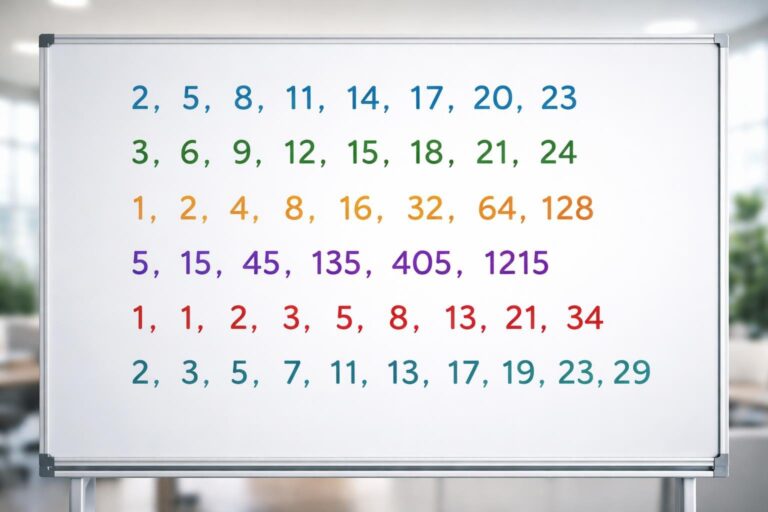
Start at 2 and add 3: you get 2, 5, 8, 11, and so on. The number you add is called the common difference. You can write any term with a formula: a_n = a_1 + (n−1)d, where a_1 is the first term and d is the difference.
You’ll spot arithmetic sequences in things like evenly spaced events, step counts, or rows in a pattern. They let you use addition or subtraction instead of more complicated math. You can also solve for missing terms or find the sum of lots of terms quickly with S_n = n(a_1 + a_n)/2.
Geometric Sequences
A geometric sequence multiplies by the same number each time.
Here’s an example: 3, 6, 12, 24, … (multiply by 2 each time). Or 10, 5, 2.5, … (multiply by 0.5). The multiplier is the common ratio. To find any term, use a_n = a_1 * r^(n−1).
You’ll see geometric patterns in multiplication tables, compound growth, or repeated scaling. Use them when doubling, halving, or applying percent change over and over. The sum of a geometric series has its own formula, so you don’t have to list every term.
Special Sequences and Numbers
Some sequences follow their own geometric or combinational rules.
Fibonacci numbers, for example, come from adding the two previous terms: 0, 1, 1, 2, 3, 5, 8, 13, … You’ll see this one in nature and in puzzles. Triangular numbers count dots in a triangle: 1, 3, 6, 10, … Square numbers are 0, 1, 4, 9, 16, … from n×n. Then there are cube numbers: 1, 8, 27, 64, … from n×n×n.
These special sequences tie into geometry and algebra. You can use triangular, square, and cube numbers to model shapes or spot algebraic identities. Recognizing these forms helps you solve pattern problems and predict the next terms quickly.
Visual and Algebraic Patterns
You can spot patterns in shapes or in equations.
Visual patterns show up with things like dots, tiles, or symmetry, and you can actually see how a sequence grows. For instance, square numbers build bigger and bigger squares, while triangular numbers just add another row of dots every time. Sometimes, symmetry jumps out and you notice a repeating structure you can count.
Algebraic patterns, on the other hand, rely on rules and formulas. Input-output tables connect x to something like 2x+3. You might test a few values or compare differences and ratios to figure out the rule. Mixing the visual and algebraic sides makes problem solving a bit more natural, and honestly, it just helps you get a better feel for trickier math down the road.