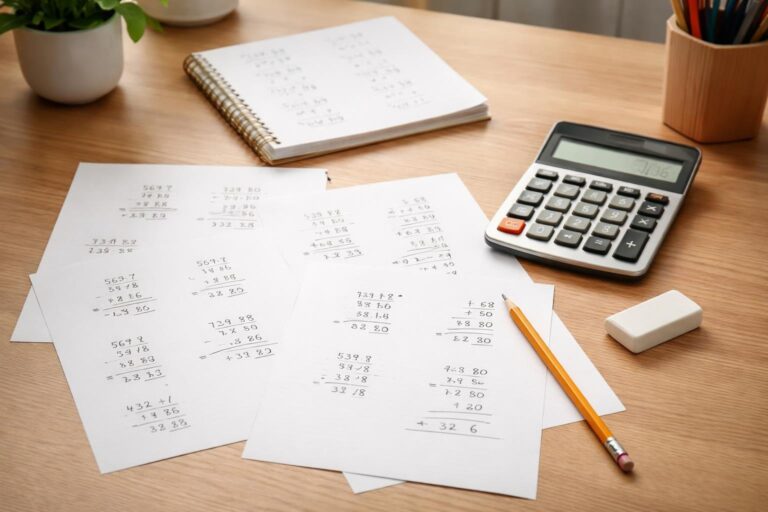

Mathematicians in Daily Life: Everyday Math and Its Applications
You probably use math way more than you realize—whether you’re cooking, making a budget, fixing a leaky pipe, or just figuring out the fastest way to get to work.
Mathematicians actually design a lot of the rules, tools, and methods behind those everyday choices, so your world runs a bit smoother and decisions get a little clearer.

This article digs into how real mathematicians shape daily routines and the tech you rely on, from simple calculations to the algorithms humming inside your phone.
Let’s check out some practical examples that tie math to stuff you do every single day.
Essential Roles of Mathematicians in Daily Routines

Math helps you handle money, time, and measurements all the time.
You use arithmetic, percentages, ratios, and a bit of algebra when you plan, compare, and make decisions.
Budgeting and Managing Personal Finance
You track income, fixed bills, and random expenses with basic arithmetic and subtraction.
To make a monthly budget, just list all your income, then subtract rent, utilities, and debt to see what’s left.
If you want to save, use percentages—maybe stash away 10% or 20% of your income—and watch it slowly add up.
Compound interest makes a difference when you pick savings accounts or loans.
Even small changes in interest rates or payment frequency can change what you pay or earn.
Algebra actually helps you figure out monthly payments or how long it’ll take to reach a savings goal.
Try simple statistics to spot where your money goes.
Maybe compare your average weekly food spending over a few months and see if you can cut back.
When you travel, currency conversion matters—just multiply prices by the exchange rate and add a little extra for fees.
Shopping and Calculating Discounts
Shopping? You use percentages and arithmetic to grab the best deal.
If something’s 25% off, multiply the price by 0.75 and you’re set.
When there are two discounts, apply each one after the other—don’t just add the percentages.
Compare unit prices to see which brand or size is actually cheaper.
Divide price by quantity (like price per ounce or item) to make a fair comparison.
Ratios help when packages come in different sizes or counts.
Watch out for “buy one get one” deals and sales tax.
Figure out the real price per item after the offer, then add tax if you need to.
This way, you can avoid impulse buys and actually save money.
Cooking, Baking, and Measuring Ingredients
Scaling recipes uses ratios and proportions.
If a recipe for 4 needs to feed 6, just multiply each ingredient by 6/4.
Keep measurements consistent—sometimes you have to convert cups to milliliters or ounces.
Baking needs precision.
A small mistake in proportions can mess up texture or rise.
Use basic fractions and decimals to halve or double recipes accurately.
A kitchen scale and knowing how to convert units really help.
Timing and temperature need math too.
If you change pan size or oven temp a bit, adjust the cooking time.
To budget meals, divide the total recipe cost by the number of servings for a per-serving estimate.
Time Management and Scheduling
You plan your day using addition, subtraction, and sometimes division.
Add up how long tasks take to see if they’ll fit into your schedule.
Break big projects into smaller timed blocks—work for 50 minutes, take a 10-minute break.
Use proportions to split your time between priorities.
If homework needs 3 hours and chores 1 hour out of 4, give each task time that matches those ratios.
For repeating events, calculate how often they happen and set reminders so things don’t overlap.
When you travel, add travel time to your departure to figure out when you’ll arrive.
Adjust for time zones by adding or subtracting hours so you don’t miss anything important.
Mathematics Integrated with Modern Technology and Problem Solving
You use math every single time you trust a device, send a secure message, or plan a route.
The examples below show the math powering the software and systems you rely on.
Algorithms and Computing
Algorithms are step-by-step math rules that make computers work.
You see them in search engines, recommendations, and even machine learning.
They use data structures, set theory, and graph theory to store and find information fast.
Linear algebra runs under the hood of neural networks and computer graphics.
Matrices and vectors make image transforms and 3D rendering possible.
Calculus and differential equations model change in simulations, physics engines, and signal processing.
Optimization methods—like gradient descent and logistic regression—tune models for stuff like classification and risk.
Knowing how complex an algorithm is helps you pick faster, more efficient code that doesn’t slow down with big data.
When you use AI features, statistical modeling and careful data analysis help reduce bias and make things more accurate.
Cryptography and Data Security
Cryptography protects your messages and transactions with number theory and modular arithmetic.
RSA uses huge prime numbers and the challenge of factoring them; it’s behind secure key exchanges in lots of older systems.
Elliptic Curve Cryptography (ECC) uses elliptic curves to get similar security with smaller keys, which speeds things up and saves bandwidth.
Hash functions turn your data into fixed-size digests for checking integrity and storing passwords.
Secure protocols mix asymmetric and symmetric cryptography to balance speed and security.
You should expect strong randomness, good key management, and current algorithms to avoid getting hacked.
Cryptographic math connects directly to cybersecurity, protecting banking, health records, and online services from tampering and eavesdropping.
Technology in Navigation and Logistics
People working in navigation and logistics lean heavily on geometry, statistics, and optimization to keep things moving smoothly. GPS works because satellites shoot timing signals down to Earth, and you crunch the numbers to figure out your coordinates.
Signal processing and error models step in to boost accuracy and handle those annoying atmospheric delays. For route planning, graph theory and shortest-path algorithms come into play.
When you need to figure out which vehicles go where, combinatorial optimization helps cut down on both cost and wasted time. Geographic Information Systems (GIS) mix spatial data with statistical modeling—great for things like forecasting demand or picking the right spot for a new warehouse.
In logistics, teams use forecasting, inventory models, and risk assessment, all powered by time-series analysis and probability. So, whether you’re tracking a package, finding the most fuel-efficient route, or piecing together a supply chain, applied mathematics quietly runs the show, balancing accuracy, speed, and cost.