
Real Life Examples of Symmetry: Nature, Design, and Geometry
You probably spot symmetry everywhere, even if you don’t think about it—on a butterfly’s wings, in the petals of a flower, or on the face of a building. Symmetry just makes things look balanced, and honestly, it helps us copy, design, and even understand patterns more easily. We’ll break down how basic symmetry works and show you some real examples from nature, architecture, and everyday design. I mean, it’s surprisingly simple and useful once you notice it.

As you scroll through, expect quick explanations of the types of symmetry you bump into daily, plus some examples you’ll probably recognize next time you step outside or flip through a magazine.
The idea here is to make symmetry feel familiar and practical—so you start spotting it everywhere.
Fundamentals of Symmetry in Everyday Life

Let’s get into what symmetry actually means, how the common types work, and how lines of symmetry create those mirror images in stuff you see all the time.
These ideas link geometry to things like nature, art, and design in ways that just make sense.
What Is Symmetry?
Symmetry means a shape or object matches itself when you change it in a certain way. In geometry, that change could be flipping, rotating, or sliding it.
When the change puts the object right back onto itself, you’ve got symmetry.
You can test for symmetry with easy tricks. Fold a piece of paper and check if both sides line up. Or spin a star around its center—if it looks the same at different angles, that’s rotational symmetry.
Some key words: axis (that invisible line you flip across), mirror image (the flipped side you get), and line of symmetry (the spot where halves match up). These terms help you explain why a leaf, a logo, or even a building just feels balanced.
Types of Symmetry and Their Characteristics
Reflectional (or bilateral) symmetry splits something into two mirror-image halves across an axis. Think of human faces or butterfly wings.
One side reflects the other, either across a vertical or horizontal line.
Rotational symmetry shows up when an object matches itself after you turn it around a center point. A five-pointed star, for example, repeats every 72 degrees. The number of times it matches in a full turn? That’s its order of rotational symmetry.
Translational symmetry is when a pattern repeats because you slide it along a direction—like you see in wallpaper or tiled floors.
Glide reflection? That’s a mix of a slide and a flip, like the way footprints line up along a path.
Each type has its own vibe. Reflection gives you balance. Rotation creates a kind of rhythm around a center. Translation builds repeating patterns.
If you can spot the type, you can usually predict or describe how the shape will behave.
Lines of Symmetry and Mirror Images
A line of symmetry (or axis) splits a figure so every point on one side matches a point on the other.
For reflectional symmetry, this line acts like a mirror you could fold the shape along.
You can hunt for lines of symmetry by folding, using a mirror, or just tracing matching points. Simple shapes make it obvious: a circle has infinite lines, an equilateral triangle has three, and a rectangle has two.
Some shapes don’t have any at all.
Mirror images flip left and right across the axis but keep the same distance from it.
That’s why when you see a word printed backwards, it’s a mirror image—letters swap orientation. In design and biology, mirror images help create that balanced look and let you spot forms quickly.
Real Life Symmetry: Examples in Nature, Architecture, and Design
You’ll bump into symmetry in living things, buildings, and tons of everyday objects.
Check out these examples—reflectional, rotational, and translational symmetry all show up and shape the way things look and work.
Symmetry in Nature: Plants, Animals, and Natural Forms
Take a daisy or a sunflower. You’ll see radial symmetry—petals arranged around a center point.
Lots of flowers use this setup to guide pollinators right to the nectar.
Trees and leaves often show bilateral symmetry, with left and right halves mirroring each other. It helps with balanced growth and catching light.
Animals get in on the symmetry game too. Butterflies and many fish show reflectional symmetry, which helps keep movement and sensing balanced.
Starfish have rotational symmetry, repeating body parts around a center.
Snowflakes? They’re classic examples of six-fold radial symmetry, all thanks to water crystal patterns forming in cold air.
Shells often show point or spiral symmetry, connected to how they grow.
These patterns don’t just happen by accident. They come from genetics, cell division, and physics.
You can measure symmetry using simple lines, centers, or repeating units—it’s a neat way to compare shapes and growth.
Symmetry in Man-Made Structures and Art
Architects and designers lean on symmetry to make spaces feel solid and pleasing.
The Taj Mahal and lots of classical facades use reflectional symmetry along a vertical line.
Public squares and gardens often use axial symmetry to guide how people move or where they look.
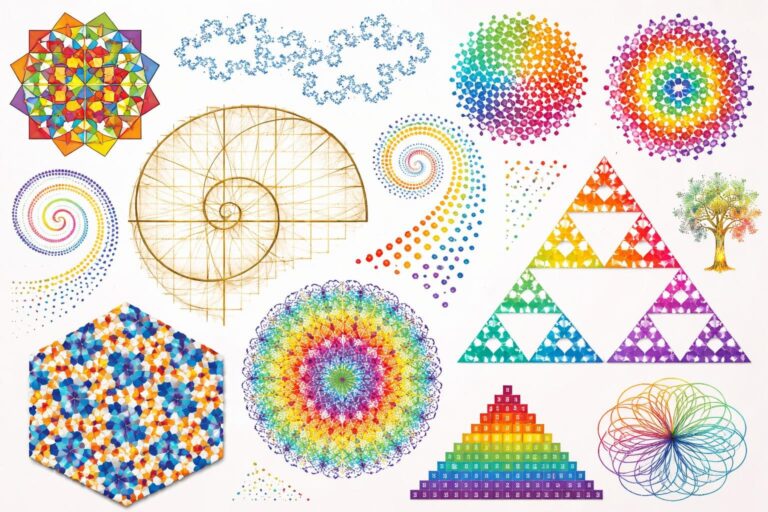
Artists love rotational symmetry in things like mandalas or kaleidoscopic designs—it draws your eye right to the center.
Tile work? Translational symmetry all the way—a basic pattern repeats to cover floors and walls, no gaps.
Logos often use bilateral or radial symmetry to make a mark that’s balanced and easy to remember.
Engineers use symmetry too. It can make structures stronger and help things work better.
Bridge trusses and circuit layouts use mirrored parts to spread out the load and cut down on interference.
You can check designs by folding, rotating, or sliding patterns to see if symmetry sticks.
Applications of Rotational, Reflectional, and Translational Symmetry
Reflectional symmetry—sometimes called line symmetry—shows up when you compare the left and right sides of faces, wings, or even building fronts. You can spot the line of symmetry by folding or imagining a shape reflected across an invisible mirror.
This kind of symmetry brings balance and often makes manufacturing simpler. It just feels satisfying when things line up like that, doesn’t it?
Rotational symmetry pops up when a shape repeats around a central point. Think about clocks, turbines, or the way some flowers arrange their petals. These designs spread forces or grab your attention from every direction.
You can check for rotational symmetry by turning the shape at a set angle. If it looks the same, then you’ve got rotational symmetry.
Translational symmetry happens when you slide a motif without spinning it. You’ll see this in wallpaper, brickwork, or textile patterns. Designers use translational symmetry to tile a surface neatly.
It keeps the building blocks identical, which makes production smoother and cuts down on waste. That’s pretty practical, right?
Point symmetry and line symmetry also come into play when you’re analyzing or designing something. You can use these to simplify math models or avoid construction mistakes.
They help you create patterns that repeat in a predictable way.