
Examples of Symmetry in Daily Life: Types, Patterns, and Real-Life Uses
You spot symmetry just about everywhere—think butterfly wings, flower petals, or even the front of a building. These familiar sights make it easier to notice how reflection, rotation, and pattern shape the world around you.

Symmetry pops up in nature, art, and the objects you use every day. When you look for it, you start to see the big types and why they actually matter. This post walks you through real, everyday examples and breaks down the different kinds of symmetry you probably run into all the time.
As you read, keep an eye out for patterns in design, biology, and technology. You’ll probably catch mirror images, radial layouts, and repeating motifs in things you barely noticed before.
Understanding Symmetry Through Everyday Examples

You’ll notice symmetry in plants, animals, objects, and buildings. Watch for mirror-like halves, repeated segments around a center, and obvious lines where shapes match up.
Symmetry in Nature
You can spot symmetry in so many living things. Flowers like daisies and sunflowers have radial symmetry—petals repeat around a center point.
This makes the flower look the same if you turn it. Snowflakes do this too, usually with six identical arms. Animals, on the other hand, usually show bilateral symmetry. A butterfly’s left wing mirrors its right wing along a vertical line.
Starfish and some sea creatures have radial symmetry, with arms or parts arranged around the center. These patterns help with movement, feeding, or even attracting mates.
Symmetry in nature isn’t always perfect, though. You’ll see small differences, but the basic mirror image or repeating pattern usually stands out.
Symmetry in the Human Body
Your body mostly follows bilateral symmetry. If you draw a vertical line down your center, your left and right sides look pretty similar.
Eyes, ears, arms, and legs all pair up across this line. This mirror image helps you stay balanced and move smoothly.
Some organs break the pattern, though. Your heart sits a bit to the left, and your liver’s mostly on the right. Still, a lot of your features follow clear reflection symmetry.
Try standing straight in front of a mirror and looking at your face. You’ll notice both sides are close, but not quite identical. That little bit of difference is just how biological symmetry works in real life.
Symmetry in Everyday Objects
You run into symmetry in all sorts of everyday things. Forks, spoons, and plenty of tools have bilateral symmetry, so they feel balanced when you hold them.
Tires and wheels show rotational symmetry—spokes repeat around the center, making the wheel roll smoothly. Logos and signs often use reflection symmetry to look stable and neat.
Mirrors, obviously, create perfect reflection symmetry of whatever’s in front of them. Even simple crafts, like cutting folded paper, reveal lines of symmetry along the crease.
Try folding or imagining a fold to find the line of symmetry. If the halves line up, that’s reflection symmetry.
Symmetrical Patterns in Art and Architecture
Artists and architects love using symmetry to create balance and beauty. Islamic tilework features repeated geometric patterns with clear lines of symmetry.
Buildings like the Taj Mahal use a central axis so each side mirrors the other. In art, kaleidoscope images use mirrors to create rotational and reflection symmetry.
Modern logos often mix bilateral symmetry with simple shapes to make them more recognizable. Architects arrange windows, doors, and columns symmetrically, making buildings feel orderly and stable.
When you look at a design, try to spot lines of symmetry or a central point. Those lines help explain why the pattern repeats and why the design feels balanced.
Types of Symmetry Seen in Daily Life
You’ll see a few main types of symmetry all around you. Each one follows a basic rule for how parts match or repeat, and you’ll spot them in real-world objects and designs.
Reflectional Symmetry
Reflectional symmetry (sometimes called line symmetry or mirror symmetry) happens when one side of something matches the other if you fold or draw a mirror line down the middle.
Test it by picturing a vertical or horizontal line through an object and seeing if the halves match. Faces, butterfly wings, and lots of building façades show this type.
Key things to notice:
- Line of symmetry — the imaginary line where the mirror would sit.
- Bilateral symmetry — when there’s just one main line, like with people.
- Multiple lines — some flowers, for example, have several mirror lines.
Designers often use reflectional symmetry to make logos, furniture, and patterns feel balanced and easy to recognize. If one half is a bit different, the object still looks balanced, even if it’s not perfectly symmetric.
Rotational Symmetry
Rotational symmetry shows up when an object looks the same after you turn it around a center point by a certain angle. The smallest angle that lines up the object with itself is the angle of rotation.
The number of times it matches in a full 360° turn gives the order of rotational symmetry.
You’ll spot rotational symmetry in things like:
- Wheels and gears (the order depends on the spokes).
- Snowflakes (usually six-fold rotational symmetry).
- Kaleidoscope patterns and some floral designs.
If an object has order 4, it matches at 90°, 180°, 270°, and 360°. Try rotating an image on your screen or turning a real object and see when it repeats.
Translational Symmetry
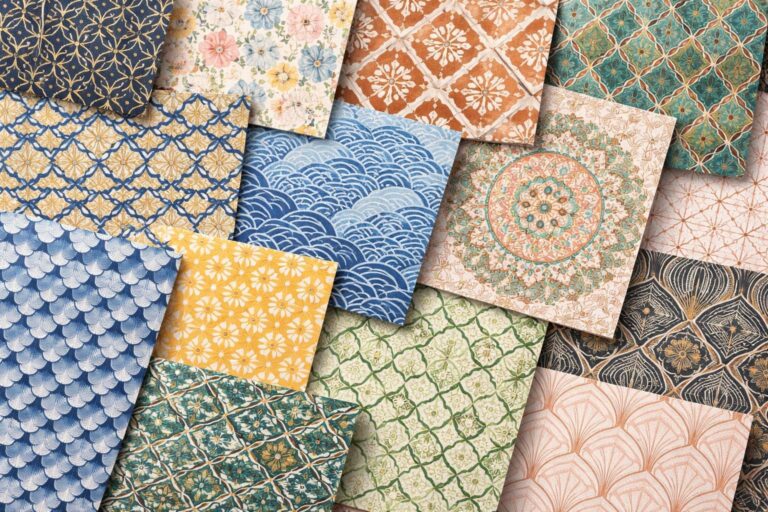
Translational symmetry happens when a pattern repeats by sliding (translating) along a direction, without rotating or flipping. The unit shifts by a set distance and direction to make a continuous pattern.
You’ll see this in wallpaper, tiled floors, and brickwork.
A few things to keep in mind:
- Translation vector — shows the direction and distance of the repeat.
- Repeating unit — the basic shape that gets copied.
- Frieze patterns — long borders or bands often show translational symmetry, sometimes mixed with other types.
Translational symmetry helps manufacturers and architects create surfaces that are cheap to produce and easy to extend, while still looking consistent.
Point Symmetry
Point symmetry, sometimes called central symmetry, happens when every part of an object lines up with another part that’s directly opposite, across a central point, and at the same distance.
If you spin the object 180°, it ends up looking exactly the same. That’s actually a special kind of rotational symmetry—specifically, order 2.
Some examples? Well, think of certain letters or numbers, like S or 0, depending on the font.
You might also spot it in decorative motifs or simple geometric shapes.
A few logos pull this trick too, flipping around a center point.
Want to check for point symmetry? Just pick out the center point, then see if each part has a matching piece straight across from it.
If every element matches up like that, congrats—the object has point symmetry.