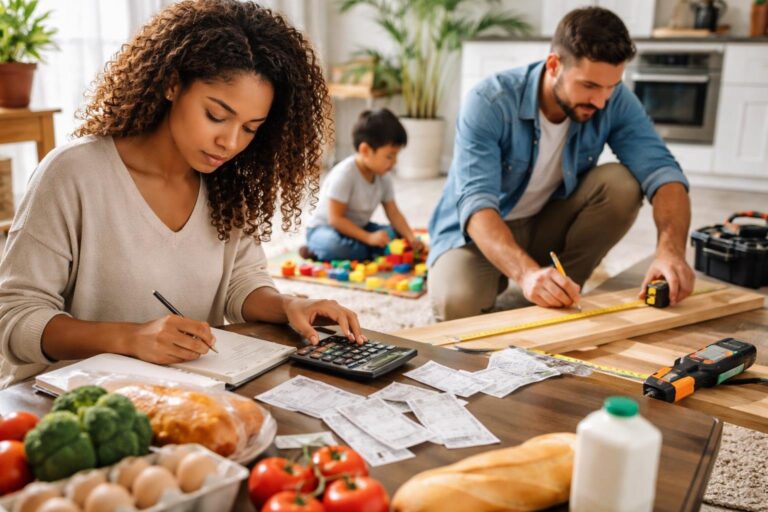

Math in Real Life Examples: Practical Uses You See Every Day
You use math every single day, even if you’re not really aware of it. Whether you’re planning a budget, cooking dinner, measuring for a home project, or just checking how long your commute will take, math quietly helps you make smarter decisions and saves you both time and money.
Math pops up in budgeting, cooking, shopping, time management, and even in those apps on your phone—so you end up using basic math to solve real problems all the time, probably without noticing.

Let’s look at some clear, everyday examples and the simple ideas behind them. You’ll probably spot math in your own life and, hopefully, feel a bit more confident using it.
You’ll see short, practical examples that connect daily tasks to stuff like percentages, ratios, geometry, and some basic stats.
Common Math in Real Life Examples

You use quick calculations every day to make better choices with money, time, or even just picking what to buy or cook. Those skills? Adding, subtracting, multiplying, dividing, figuring out percentages, and estimating—nothing fancy, but super useful.
Budgeting and Money Management
When you plan a budget, you list your income and fixed expenses, then subtract to see what’s left over for savings or spending. Add up your total income, subtract your bills, and you’re halfway there.
Want to estimate yearly expenses? Just multiply your monthly costs by 12. Percentages help you set savings goals. Saving 10% of a $2,000 paycheck? That’s $200 you put aside.
Ratios make splitting money easier—think 50:30:20 for needs, wants, and savings. Track those little daily purchases by adding them up, so you don’t overspend.
If you want to know if something’s worth buying, divide the total cost by how many times you’ll use it. That gives you the cost per use.
A quick table helps keep things straight:
| Item | Monthly ($) | Notes |
|---|---|---|
| Rent | 800 | Fixed |
| Groceries | 300 | Estimate |
| Savings | 200 | 10% goal |
Shopping and Comparing Prices
You check unit prices to find better deals. Divide the total price by the weight or volume, and you get the price per unit. For example, $4.50 for 1.5 kg? That’s $3.00 per kg.
Don’t forget to compare using the same units. When you see a sale, percentages come in handy. A 25% discount on $60 means you multiply 60 by 0.25 to get $15 off, so you pay $45.
Add up discounts or taxes with simple addition. Subtract to see your real savings. Buying in bulk? Multiply the cost per item by how many you need—if a 12-pack costs $9, that’s $0.75 each.
Estimating the total helps you stick to your budget and avoid those impulse buys.
Cooking and Measuring Ingredients
Cooking or baking? You use ratios and measurements all the time. If a recipe serves four but you only need two, just divide each ingredient by two.
Need more servings? Multiply everything. Even small measurement errors can mess up your results, so it pays to measure carefully.
Sometimes you have to convert units—like teaspoons to tablespoons (3 tsp = 1 tbsp), or grams to cups using a chart. Add up ingredient amounts, subtract for leftovers, and for baking, weighing ingredients really pays off.
If you scale a recipe by 1.5, multiply every ingredient by 1.5. Use fractions or division when you split recipes, and jot down changes so you can repeat your best results next time.
Time Management and Scheduling
You estimate how long tasks take by timing yourself and adding up those minutes. Homework takes 40 minutes, chores take 20—block out an hour.
Split long tasks into equal parts with division, like breaking up 120 minutes of studying into two 60-minute sessions. Build your schedule with addition and subtraction. Start time plus duration equals end time.
If you start at 3:15 PM and study for 75 minutes, you’ll finish at 4:30 PM (3:15 plus 1 hour 15 minutes). Multiplication helps when you plan repeated intervals, like a 15-minute break every 45 minutes.
Percentages show how much of your day goes to something. Work 8 hours out of 16 waking hours? That’s 50% of your day. Estimating time helps you actually finish what you plan.
Mathematical Concepts in Everyday Situations
You use math constantly to measure, compare, plan, and make decisions. The next few paragraphs give some practical ways geometry, algebra, functions, probability, and stats show up in real life.
Geometry and Home Improvement
You rely on geometry when measuring rooms, cutting materials, or arranging furniture. To buy flooring, multiply length by width for rectangles. For a 12 ft by 10 ft room, you’ll need 120 sq ft, plus a little extra—usually 5–10% for waste.
Ratios and proportions help when you scale a paint plan or resize a layout. If one can covers 350 sq ft and your wall is 700 sq ft, you’ll need two cans.
You use right triangles and the Pythagorean theorem to check if carpets or TVs fit diagonally. Geometry guides the angles for shelves and stairs, making sure everything lines up and distributes weight properly.
When you need to figure out materials, shapes, perimeters, and volume come into play. Calculate volume for concrete or soil by multiplying length, width, and depth. These quick formulas keep your projects on track and help you avoid mistakes.
Algebra and Real-World Problem Solving
Algebra lets you turn word problems into equations you can actually solve. Say you want to save $2,400 in 12 months—let x be the amount saved each month. You set up 12x = 2400, so x = 200.
You use negative numbers to track debt or temperature drops. Square roots pop up in distance or area problems when you’re missing a side.
Algebra helps you think logically: isolate variables, rearrange terms, and double-check your units. Simple formulas come in handy: speed equals distance divided by time, which helps you plan trips.
Step-by-step calculations in spreadsheets make budgeting easier. Algebra takes messy word problems and turns them into clear steps you can actually use.
Functions and Daily Applications
Functions connect inputs to outputs in predictable ways you depend on. For example, a phone plan might cost f(x) = base + rate × minutes. If your base is $20 and the rate is $0.05 per minute, then f(200) = 20 + 0.05×200 = $30.
You use functions in cooking (scaling ingredients), finance (interest based on principal and time), and even with your devices (battery life depending on usage). When you graph a function, you can compare options visually—the slope shows how quickly cost or distance changes.
Understanding functions helps you solve problems and think logically. You can try out scenarios, plug in numbers, and see what happens. Many algorithms and security basics rely on functions, so this skill really ties into data and tech stuff too.
Probability and Statistics in Decision Making
You use probability and statistics every day to weigh choices and make sense of data.
When you check the weather, you see a 30% chance of rain and know it’s not a guarantee—just a possibility.
Shopping? You probably compare prices and discounts by looking at averages or quick percentages.
Statistics help you track expenses, find averages, and spot trends in your monthly budget.
If you run a quick survey, you can use probability to figure out how much you should trust the results.
In health or manufacturing, people rely on rates and proportions to guide decisions about risk or quality.
Probability shows up in games, investments, and even planning your route somewhere by helping you guess what’s most likely.
Mixing basic probability with a bit of logic just makes it easier to make choices that actually make sense.