Lottery Probability: Understanding Your Chances of Winning
When you play the lottery, it really helps to know your chances—otherwise, you might end up with some pretty wild expectations. Lottery probability just tells you how likely it is that your numbers will match the winning ones.
Honestly, the odds of hitting a typical lottery jackpot are almost laughably low—usually something like 1 in several million. That’s just because there are so many possible combinations.
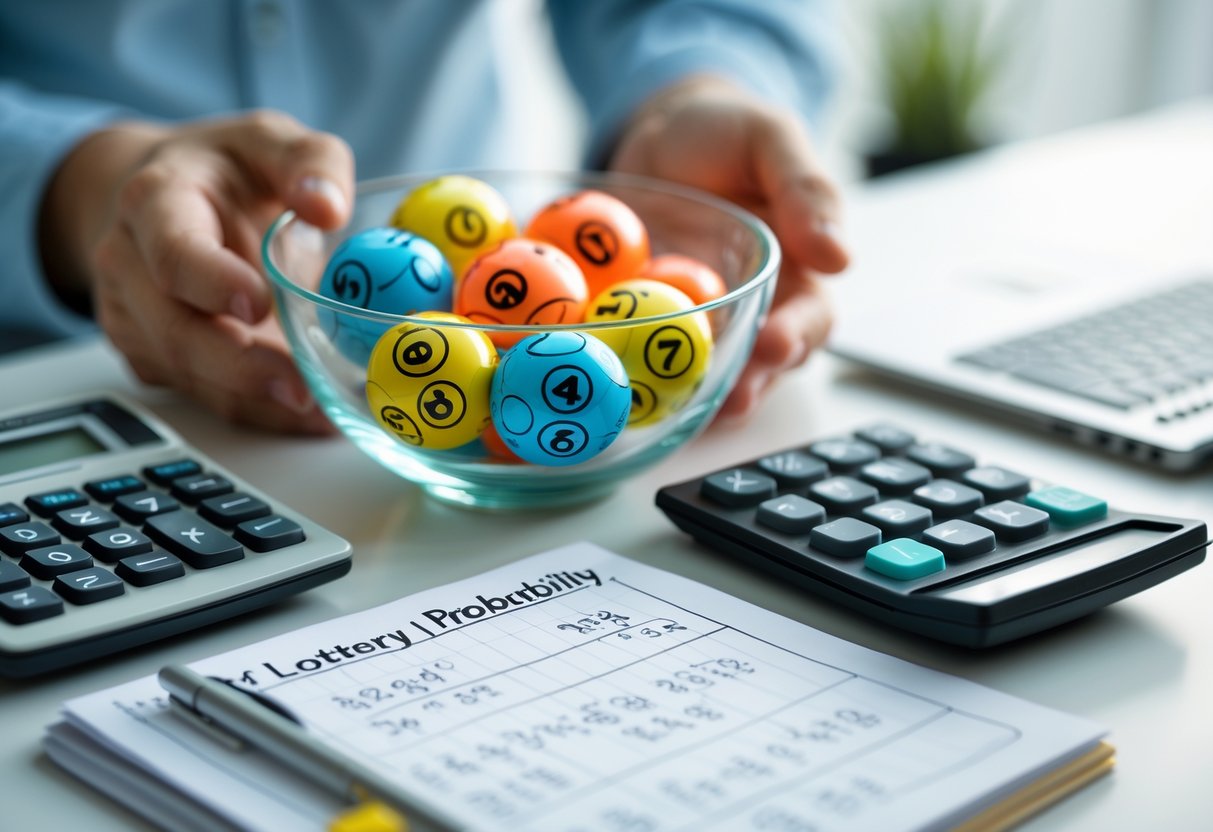
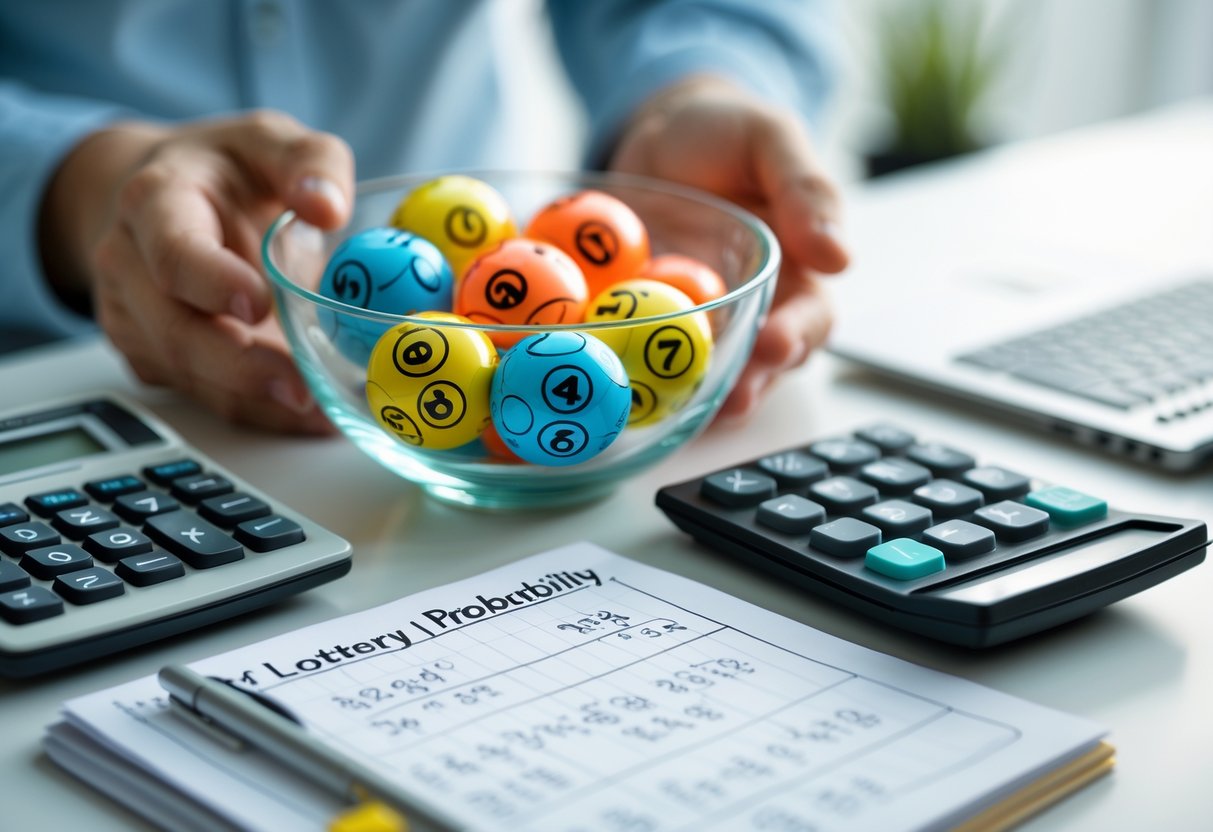
Mathematicians use combinatorics to figure out these probabilities. Basically, it’s the math of counting all the ways you can pick numbers.
Knowing this stuff helps bust common myths, like thinking you’re “due” for a win or that some numbers are luckier than others. Each lottery draw stands alone—your odds don’t budge, no matter what.
Some lotteries throw in extra sets of numbers, like regular balls plus power balls, and that really changes your odds. If you understand how this works, you’ll see why winning is so rare and why most “strategies” don’t really move the needle.
Core Principles of Lottery Probability

If you want to get lottery probability, you’ve got to know how likely you are to win based on all the ways you can pick winning numbers. That means using some basic math rules and formulas for counting combinations.
You can actually walk through the calculation yourself—it’s not as scary as it sounds.
Fundamentals of Probability in Lotteries
Probability just measures how likely something is to happen. In the lottery, it’s about your ticket matching the winning numbers.
To get your odds, divide the number of winning combinations by all possible combinations. So, let’s say you pick 6 numbers from 49—there’s only one combo that wins, the exact set drawn.
That ratio gives you your real chance, and it’s tiny. Every ticket you buy has the same probability of winning, and buying more doesn’t change the odds for each ticket.
It’s really a fixed-odds game, no matter how you look at it.
Role of Combinatorics in Lottery Calculations
Combinatorics is just a fancy word for counting how you can group things without caring about the order. Lotteries only care which numbers you picked, not the sequence.
When you choose lottery numbers, combinatorics tells you how many different sets you could possibly pick. That total number sets your odds.
You can’t pick the same number twice in one group, so the math only counts unique combinations. Combinatorics keeps things honest and avoids mistakes.
Binomial Coefficient and Combinations Formula
We use the binomial coefficient to figure out how many ways you can pick items—super important for lottery odds. People write it as “n choose k” or C(n, k):
- n is all the numbers you can pick from,
- k is how many you actually pick.
Here’s the formula:
[
C(n, k) = frac{n!}{k! times (n – k)!}
]
Let’s use a 6/49 lottery as an example:
- n = 49,
- k = 6.
So,
[
C(49, 6) = frac{49!}{6! times 43!} = 13,983,816
]
That’s 13,983,816 different six-number combos. You get one shot per ticket.
If you want to understand lottery probability, this is the math behind it.
Analyzing Lottery Odds for Different Games
Each lottery game comes with its own odds, so knowing them helps you decide which tickets (if any) are worth it. The number of balls, bonus draws, and structure all shape your chances.
Let’s break down some popular formats and see how their odds work.
Calculating 6/49 Lottery Probability
In a 6/49 game, you pick 6 numbers out of 49. To win the jackpot, you must match all 6 numbers exactly.
There are 13,983,816 possible combinations. That means your odds for the jackpot on a single ticket are 1 in 13,983,816.
If you match 3 or 4 numbers, you might win a smaller prize, but the jackpot odds barely budge. Buying more tickets just adds up your chances linearly, but doesn’t change the odds per ticket.
Probability in Powerball and Multi-Pool Lotteries
Powerball makes things trickier with two pools: one for regular balls and one for the Powerball. For example, you might pick 5 numbers from 69, and then 1 Powerball from 26.
You multiply the odds together:
- Odds to match 5 numbers: 1 in 11,238,513
- Odds to match the Powerball: 1 in 26
So, the jackpot odds come out to about 1 in 292 million. That’s… well, not great.
Multi-pool lotteries make the odds even tougher than single-pool games.
Impact of Bonus Balls and Bonus Pools
Some lotteries add bonus balls or bonus pools, drawing extra numbers that affect prizes and odds. A bonus ball might let you win a lower-tier prize without a perfect match.
These extras make the math more complicated. You might have a better shot at smaller prizes, but the total number of combinations grows.
Bonus balls increase the possible outcomes, so jackpot odds drop even further. Always check if your game uses bonus balls, since it changes what you need to win and how tough it’ll be.
Influence of Lottery Formats and Ticket Selection
Every lottery format brings its own set of rules—like how many numbers you need to pick and the range you’re choosing from. These rules really shape your chances of winning.
When you’re picking out your lottery tickets, you might want to pay attention to the format:
- If there are more numbers in the pool, your odds usually take a hit.
- When lotteries throw in bonus numbers or extra draws, the jackpot gets even harder to snag.
- Smaller games with fewer balls? Odds are better, but don’t expect huge prizes.
Some folks like to use systems or strategies to choose their numbers. But honestly, every combination has the same shot at winning. The odds come down to how many possible outcomes there are—not which numbers you pick.
Editor’s note
One thing I’ve learned from dealing with numbers regularly is that data has a personality of its own. Sometimes it behaves predictably, and other times it completely surprises you. I’ve experienced this many times when reviewing trends for NumInsight. What looks like a stable pattern can suddenly shift because people behave differently under new circumstances. I started writing this piece after noticing how often quiet changes go unnoticed until you step back and observe the bigger picture. These small moments have shaped the way I think about patterns—not as cold, fixed formulas but as living signals that react to human behaviour.