
A Rule That Describes a Pattern in Nature: Explained with Scientific Laws and Mathematical Patterns
You notice patterns everywhere—spirals on a pinecone, the way leaves stack up, or the symmetry in a snowflake. It makes you wonder: what’s behind those patterns? Usually, a scientific law or mathematical principle sums up those repeated observations and predicts how the pattern will behave. I’m going to show you how some surprisingly simple laws and equations reveal why patterns show up, and how scientists figure out which rules actually work.

You’ll see how scientists actually name and use these rules. Math can turn the shapes you see in nature into predictable models.
I’ll keep the examples plain and easy to picture. Short explanations will connect what you see to the ideas that make sense of it.
Scientific Laws: Defining Patterns in Nature
Scientific laws state repeatable patterns you can actually test and use to predict how parts of nature act. They’re usually concise, sometimes mathematical, and only work under certain conditions.
These laws fit into bigger scientific frameworks, but they stay pretty focused.
What Is a Scientific Law?
A scientific law describes a regular pattern you see in nature after lots of tests and measurements. Usually, it’s a short statement or an equation that lets you predict what’ll happen in those situations.
Scientists come up with laws through careful observation and repeated experiments. You use them when your conditions match the ones they tested.
For example, a law might tell you how a gas changes when you press on it, or how something speeds up if you push it.
A law doesn’t really dig into the “why.” It just sums up what happens, not the reason behind it.
That’s what makes laws so useful: you can calculate and predict things without having to redo every experiment.
Difference Between Scientific Laws and Theories
A scientific law lays out consistent patterns in nature. A scientific theory, on the other hand, explains why those patterns happen and ties a bunch of laws together.
If you want a direct prediction—like figuring out motion with a formula—you use a law. If you’re after the deeper reason or a bigger picture, like why gravity works the way it does, you turn to a theory.
Laws are usually more specific and easier to test directly. Theories are broader, often containing several laws and models.
Both can change if new evidence comes up, but they play pretty different roles in how we make sense of nature.
Predicting Natural Behaviors Through Laws
When you use a scientific law, you can predict how certain parts of nature will act under set conditions. Laws let you calculate outcomes fast and check those predictions with experiments or observations.
Try this approach:
- Figure out if your situation matches the law’s conditions.
- Plug your numbers into the law’s formula or statement.
- See if your predicted results match what you observe.
Laws work best within the range they were tested on. If you go outside that range, things might get weird and the law might not hold up. In that case, a broader law or a theory might do a better job.
Mathematical Patterns and Theories in Nature
You’ll run into specific mathematical rules that explain a lot of natural forms and behaviors. These include number sequences that drive growth, shapes that repeat at different scales, balanced forms around a center, and systems that can get wild from tiny changes.
Fibonacci Sequence and Golden Ratio
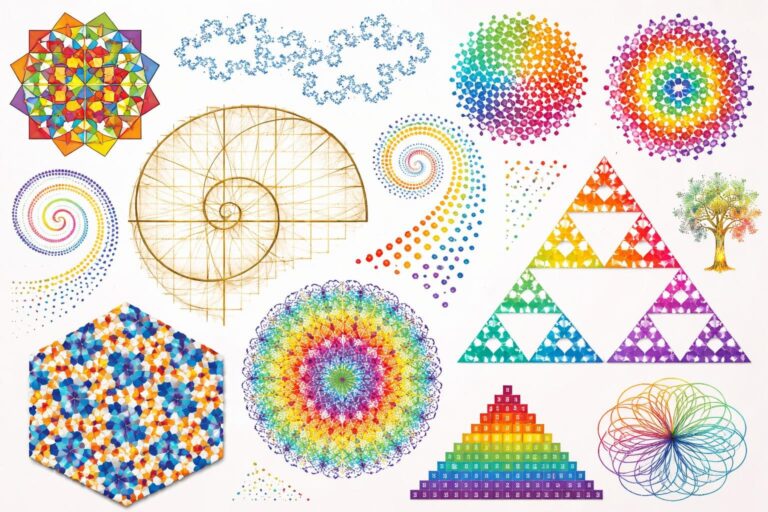
You can spot the Fibonacci sequence in tons of plants and shells. The sequence goes 0, 1, 1, 2, 3, 5, 8… and each number is just the sum of the two before it.
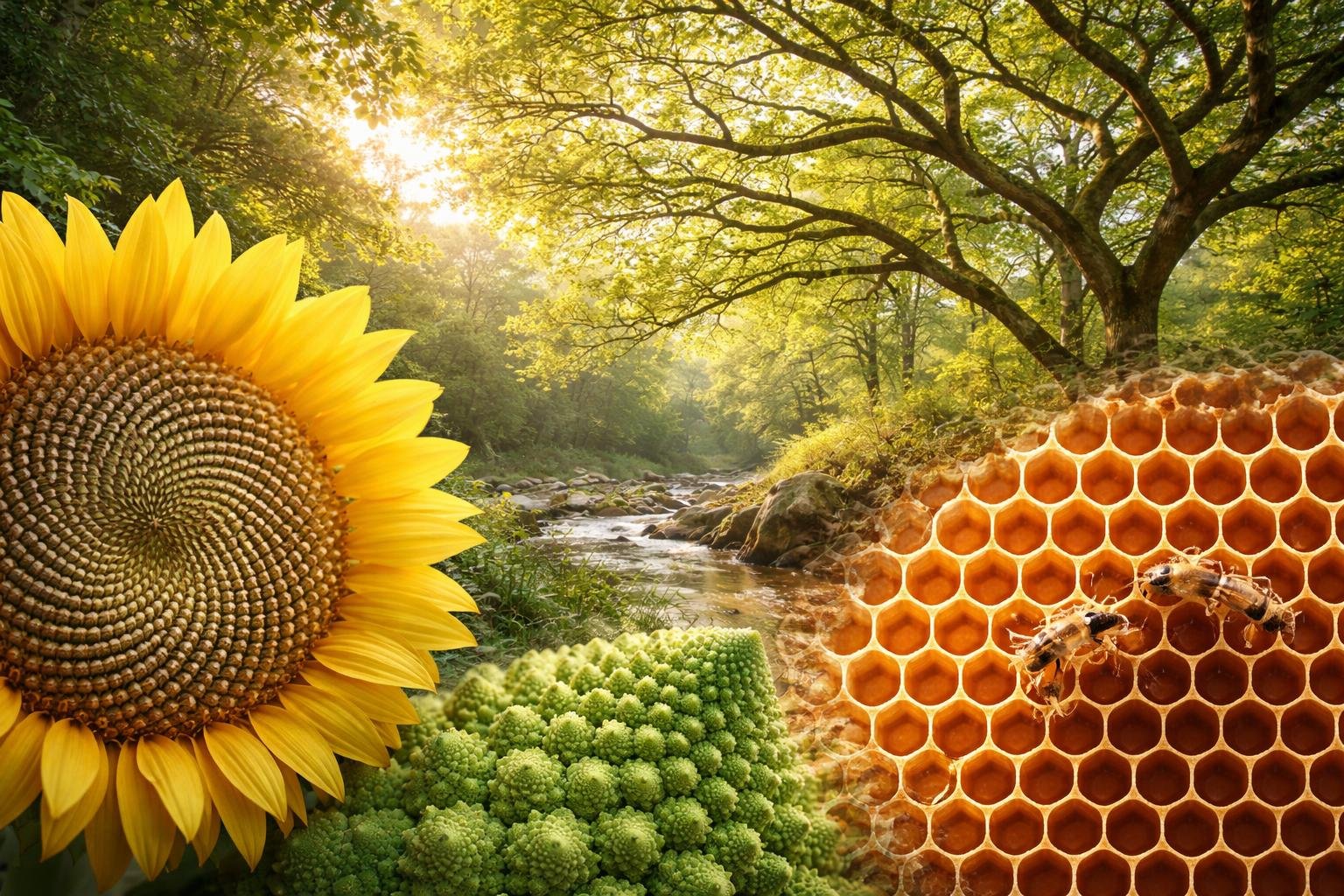
In plants, things like leaf arrangements and sunflower seed spirals line up with these numbers because it’s a super efficient way to pack stuff around a stem or seed head.
The golden ratio (about 1.618) pops up when you look at how those Fibonacci numbers relate to each other. You’ll notice it in spiral shapes and in the proportions of some shells and flowers.
This ratio connects to growth rules: if cells or plant parts always add at a steady angle, you end up with layouts that come close to the golden ratio. That helps explain how certain patterns and shapes form as things grow.
Fractals and Self-Similarity
Fractals show the same pattern over and over, at different sizes. You can see them in coastlines, fern leaves, and the way trees branch out.
Each little bit looks like a miniature version of the whole thing—scientists call this self-similarity. You can even measure how complex these patterns are with something called fractal dimension (which isn’t a whole number like regular dimensions).
Fractals usually come from repeating a simple rule and scaling things up or down. In nature, things like river channels or blood vessels split and branch this way because it’s a smart way to move stuff around or catch light.
You can model these with pretty basic math rules, and you’ll get structures that look surprisingly real over lots of different scales.
Symmetry and Rotational Forms
Symmetry shapes how things look and work. Rotational symmetry means something looks the same after you turn it by a certain angle.
Flowers often have five-way symmetry, and starfish show five arms arranged radially. You can use symmetry to sort shapes and predict how living things grow around a center.
Symmetry comes from how things develop and the physical limits they face. During growth, chemical gradients and mechanical forces can build up these patterns.
For example, reaction-diffusion systems—where chemicals interact and spread—can create spots and stripes. The symmetry of the tissue and how things start out shape what you see in the end.
Chaos Theory and the Butterfly Effect
Chaos theory digs into systems that seem to follow clear, deterministic rules, yet their behavior turns unpredictable if you tweak the initial conditions just a bit.
You’ll notice this in things like the weather or even some population models. The butterfly effect? It’s that wild idea where a tiny change at the start can snowball into something huge down the line.
In these chaotic systems, even simple equations can spin out complex, never-repeating patterns. When you model these things, it’s smart to keep an eye on how sensitive they are to their starting points—and that nonlinear feedback can really throw you for a loop.
Sometimes, pattern formation mixes chaos with reaction-diffusion or growth rules. That’s why folks often need super precise measurements and careful models if they want any hope of predicting what’ll happen.